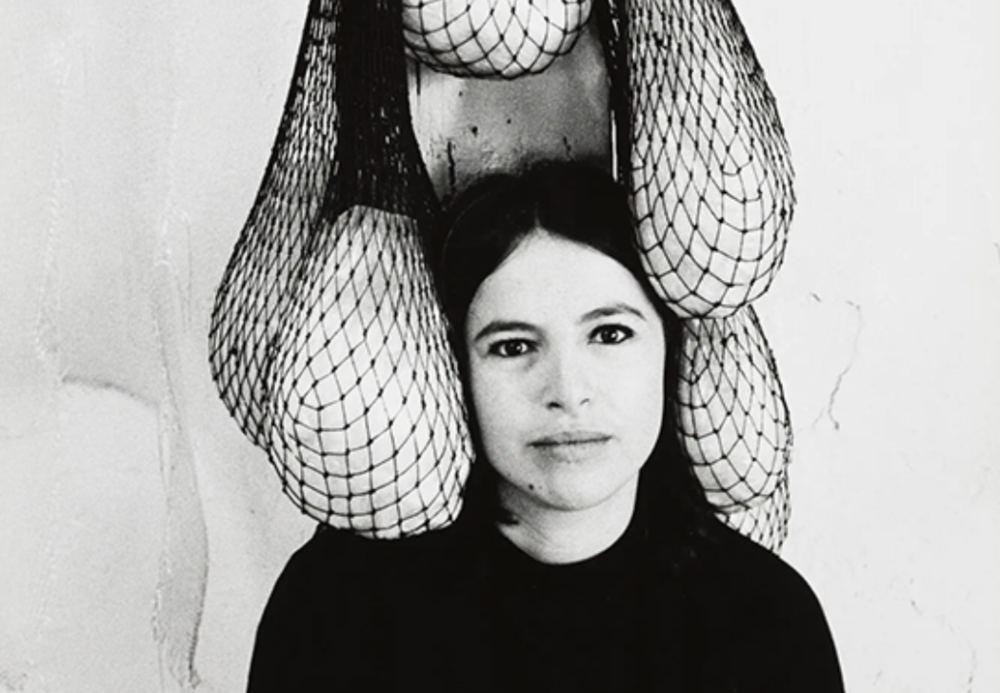
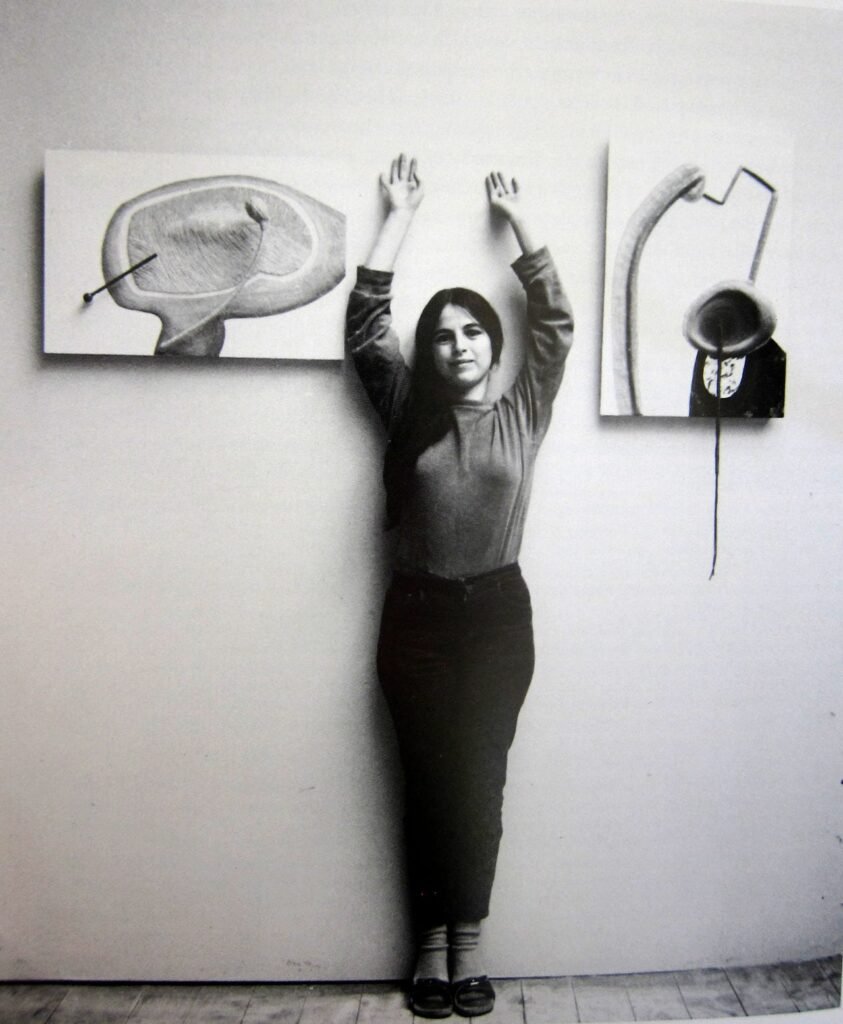
Eva Hesse (1936–1970) was a German-born American sculptor whose innovative use of unconventional materials and forms revolutionized the art world in the 1960s. Despite her brief career, Hesse’s work has left an indelible mark on contemporary art, influencing countless artists who followed.Wikipedia
Early Life and Emigration
Born on January 11, 1936, in Hamburg, Germany, Eva Hesse was the second child of Wilhelm and Ruth Hesse. In 1938, to escape the rising threat of Nazi persecution, Eva and her sister Helen were sent to the Netherlands via the Kindertransport. The following year, the family reunited in New York City, where Eva became a U.S. citizen in 1945. The Art Story+1Wikipedia+1The Guggenheim Museums and Foundation
Artistic Development
Hesse pursued art education at several institutions, including the Pratt Institute, Cooper Union, and Yale University, where she earned her bachelor’s degree in 1959. Her early work consisted primarily of abstract drawings and paintings. However, in the mid-1960s, she transitioned to sculpture, exploring materials such as latex, fiberglass, and plastics. This shift marked the beginning of her contribution to the Postminimalist movement.
Notable Works
Hesse’s sculptures are characterized by their use of unconventional materials and forms. For example, “Schema” and “Sequel” (1967–68) utilized industrial latex in innovative ways, challenging traditional notions of sculpture. Her work “Contingent” (1968) exemplifies her interest in modularity and repetition, while “Hang-Up” (1966) reflects her exploration of absurdity and extreme feeling in art.
Legacy
Despite her untimely death from a brain tumor in 1970 at the age of 34, Hesse’s influence continues to resonate. Her work is held in high esteem, with retrospectives and exhibitions held worldwide. In collaboration with the Estate of Eva Hesse, the Hauser & Wirth Institute has produced an online catalogue raisonné, “Eva Hesse Drawings,” featuring over 1,100 works on paper created between 1952 and 1970.
Eva Hesse’s innovative approach to sculpture and her exploration of unconventional materials have left a lasting imprint on the art world, inspiring generations of artists and art enthusiasts alike.
Eva Hesse’s Metronomic Irregularity II doesn’t demand attention with grand gestures. Instead, its strength lies in the understated relationship between the 2 or more intertwined forms. At first glance, it may seem like a simple, abstract piece—two figures, seemingly disconnected, occupying space on their own. But there’s a quiet bond between them, an almost imperceptible link that draws them together in a way that feels purposeful.
This piece, like many of Hesse’s works, captures the complexity of connection without trying to explain it. It reminds me of the strange, unpredictable ties that form between people, or even between souls, without clear cause or definition. These connections might feel messy, irregular, and even confusing at times, but they’re often deeper than we realize. Hesse’s work reflects that—two pieces that seem distant, yet are undeniably linked by something unseen but felt.
What makes Metronomic Irregularity II so striking is how it mirrors the bonds we form in life—those quiet connections that aren’t loud or obvious but are, in many ways, the most meaningful. The art speaks to how relationships can be both tangled and clear, a reflection of how two things can be linked without explanation.
Have you ever felt that kind of strange connection? Sometimes the art we connect with most is the art that doesn’t try to explain everything—it simply lets us feel.
